Case study 02 / Attention & audience
The Business of Being Interesting
Jump to section
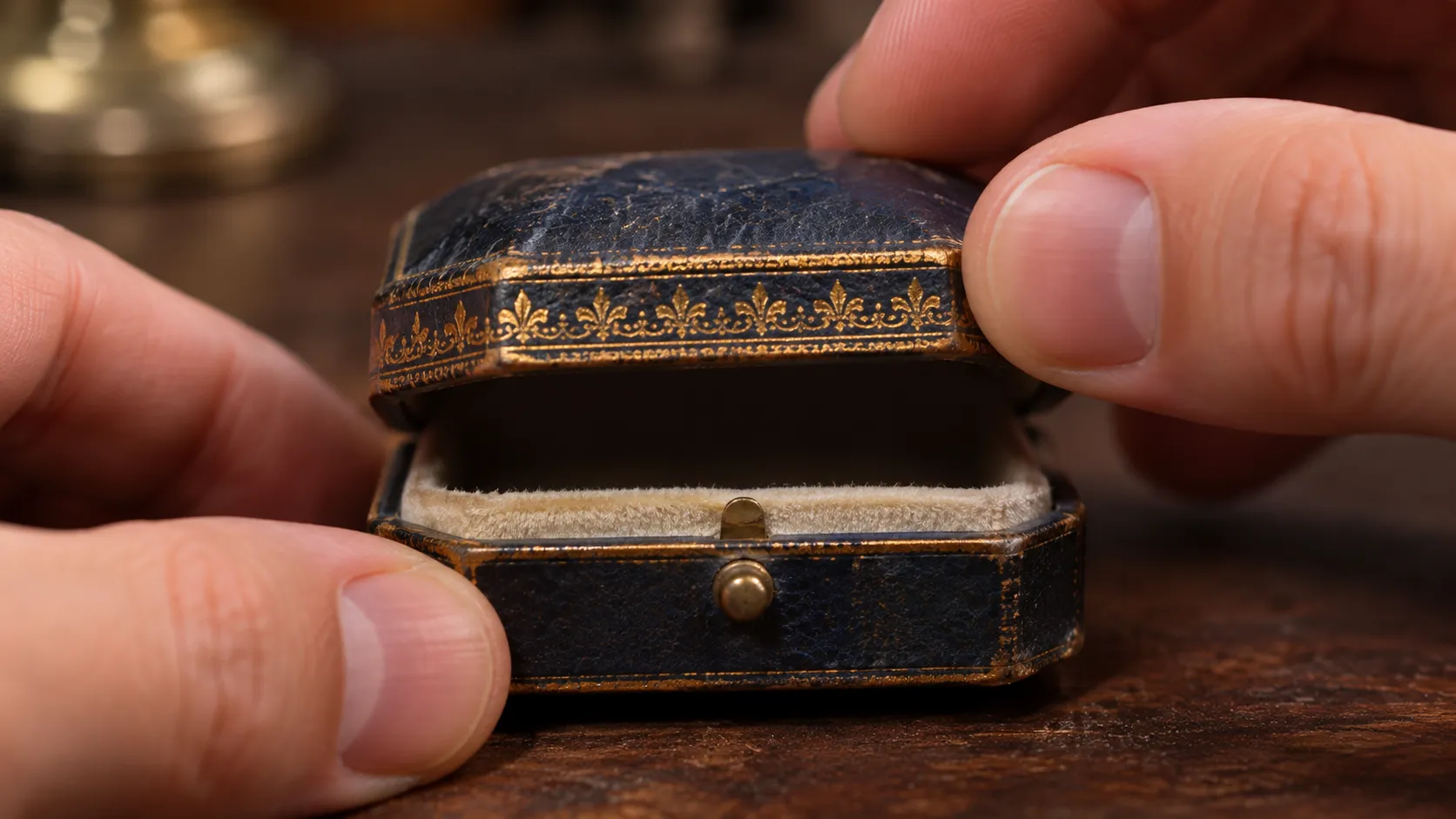
The psychology of attention, curiosity, and organic social media growth at Levy’s Fine Jewelry.
If you are one of the world’s biggest auction houses promoting jewelry previously owned by royalty, the jewelry may be enough to capture someone’s attention. In any other circumstance, the jewelry will almost certainly not be enough to win you an audience.
That might seem ridiculous or counterintuitive to a jeweler surrounded by beautiful merchandise, but consider the mindset of the person who will come across your post. There are thousands of jewelers posting nearly identical images and videos competing for the attention of every user on the platform. Pretty jewelry may have been enough to warrant attention in 2015, but social media has changed and the mindset of the people using it has evolved with it.
If your goal as a business is to grow a larger audience, you are inherently designing content for people who don’t know or care about your business. They can get a pair of diamond studs anywhere, and realistically, that’s an anniversary gift that is still 4 years away. Do you honestly think someone wants to clog up their already overwhelming feed with content that feels like a generic advertisement?
This is where understanding psychology becomes imperative. Once you understand the mentality of the person using a platform, you can understand how to accomplish the most valuable marketing win in business: make random strangers genuinely interested in supporting your business and engaging with your content.
The Art of Making People Care
Jewelry presents an unusual marketing challenge because most people purchase it infrequently. A couple might buy an engagement ring and wedding bands, and then go years without needing anything else. Crafting content exclusively for people actively shopping for jewelry means ignoring the much larger audience of people who will be interested in the future. If you want real longevity, you have to make them care before they are interested in your products.
When I joined Levy’s in December 2013, my background was in SEO. I preferred the concept of permission-based marketing, reaching people when they were actively looking for information rather than interrupting them with something they hadn’t requested.
On my third day, Danielle from Gem Gossip visited the store and showed me her Instagram account, which had recently surpassed 10,000 followers. This was the moment I truly recognized the scale of what a social audience surrounding jewelry could be. The people who chose to follow her weren’t shopping. They enjoyed what she shared, and more importantly they were part of a community where everyone was interested in the more unique aspects of jewelry and art history.
My goal became to build an audience with this level of interest and dedication around our store, which required giving them a lot more than the opportunity to buy unique jewelry. This was especially challenging because at that point in time, it was “trendy” for young people to not really care that much about jewelry. The key to success was romanticizing the idea of jewelry as much as the jewelry itself.
Levy’s selection of vintage and one-of-a-kind jewelry was a unique advantage, but it wouldn’t be enough on its own. Plenty of accounts with smaller followings had more impressive jewelry. The posts needed to be artful and inspiring. When a user on Instagram viewed a post, it needed to become an experience they would subconsciously hold onto.
Early photography experiments involved arranging jewelry on antique books, flowers, fabrics, unusual surfaces, and loading a ton of rings on a hand.
Over time, the photography became more deliberate. Camera angles were chosen to emphasize particular details, backgrounds became less distracting, and closeups increasingly focused attention on what made each piece unusual.
Artful images were a requirement, but that wasn’t enough to make people stick around permanently. The reason people use social media is because they want to be entertained. Educating people with obscure historical stories, trying to make them laugh and showing them that we were real humans is what made them actually care.
The Algorithm Doesn’t Owe You an Audience
One of the most common misconceptions among small business owners is that social media platforms deliberately suppress organic content to force businesses into purchasing advertising.
Just because your account has thousands of followers or you used to get consistent engagement doesn’t mean the algorithm has fundamentally changed. Your audience has fundamentally changed.
Every major social media platform has one metric that affects their bottom line more than any other: keep users on the platform for as long as possible. If they can accomplish this goal, they don’t need to incentivize advertisers to spend money. Advertisers pay attention to these numbers and they will choose to allocate funds to the platforms users engage with the most.
As the platforms evolve, they offer more opportunities to help a marketer accomplish these goals.
For example, Instagram’s carousel feature offers an opportunity to capture a user’s time with up to 20 images per post. A user who enjoys a single image post may “like” or “comment”, but they will probably be finished taking in the details after a couple of seconds. If a user appreciates a carousel post, they spend 6-8 seconds viewing the images instead of 2-3. That is a 3-4x increase in user engagement. Instagram is also likely to give you a second opportunity to impress a user by showing a different image from the carousel in their feed if they scrolled past it the first time.
TikTok really changed the game in this regard, and Instagram followed along by integrating Reels into their platform. The reason is simple: people spend more time engaging with video than they do still images. Video keeps people on the app substantially longer. If you make content that captures people’s attention consistently, you don’t need ads to experience significant growth. The algorithms are still incentivized to promote your content to a massive audience for free.
TikTok and the Psychology of Anticipation
In 2020, it became obvious to me that TikTok’s extraordinary growth and recommendation system presented an opportunity that was difficult to ignore. Unlike a conventional social feed dominated by accounts someone already followed, TikTok’s “For You Page” was exceptionally effective at introducing people to unfamiliar creators. For a small business, this offered an unprecedented opportunity to explore virality.
I started taking this new challenge seriously in May, and after a week of deep investigation into understanding the algorithm, Levy’s published its first TikTok on May 29, 2020.
The video featured a large antique diamond ring being revealed from a vintage jewelry box to the song “I Dare You” by Kelly Clarkson. It received 35 views. The second video, featuring an unusually colorful opal, received 34.
The third showed an elaborate Art Deco diamond necklace being revealed from another vintage box, accompanied by a popular sound, “I am obsessed with this.”
It initially performed much like the first two before experiencing a sudden increase in distribution. After being stuck at 30 views for the first few hours, it suddenly saw an influx of more than 1,000 views in one hour. And then the distribution stopped again. This lag continued for about a week, until the algorithm began promoting the video again. Two weeks after posting the third video, it eventually surpassed 100,000 views.
Three weeks after posting our first video, Levy’s had already accumulated more than 1,000 TikTok followers and 15,000 likes. The experience illustrated a significant difference between recommendation feeds and traditional follower-based distribution. A video could reach audiences many times larger than the account’s existing following, sometimes long after its initial publication.
Early experimentation included jewelry history, unusual sounds, different filming techniques, and jewelry-cleaning demonstrations.
The cleaning videos were consistently among the strongest performers. Their appeal was visually mesmerizing as a cloud of gunk from inside a ring exploded into the cleaning solution. However, I was never quite able to find the right combination of ingredients to create the cloud in the cleaner I was chasing.
The historical explanation videos were reasonably successful, although speaking directly to a camera was clearly not my strong suit. These videos took way too much time to reach a point where I was content with the quality.
The increasingly repeatable format was the jewelry reveal.
What’s in the Box?
The retention metrics provided in TikTok’s analytics showed an interesting pattern.
When jewelry was shown immediately, 40–50% of viewers would scroll within approximately 0.2–0.5 seconds. That seems like an absurdly small amount of time to capture someone’s attention. When a ring or pendant box was the first visual, the curiosity made the viewer stick around until it was opened. That meant 40-50% of users were scrolling at around the four second mark. They didn’t really care that much about the jewelry, they just had to know what was inside that unique little box.
In 1994, behavioral economist George Loewenstein published The Psychology of Curiosity: A Review and Reinterpretation, proposing that curiosity can arise when people recognize a gap between what they know and what they want to know.
A closed jewelry box accomplishes this immediately.
The viewer recognizes the object, understands its purpose, and knows that something is concealed inside. An attractive antique box further establishes an expectation that its contents might be particularly interesting.
Showing the jewelry immediately eliminates that uncertainty. The viewer can immediately decide whether the product is interesting before the video has meaningfully begun.
This pattern creates an independent, subconscious reason to continue watching, even for somebody who has reasonably little interest in the product.
The difference between 40-50% of people scrolling immediately vs them sticking around to watch 4 seconds of an 8 second video gave significant signals to the recommendation algorithm and encouraged the organic promotion of these videos to new users.
Choreographing Attention
Once the significance of anticipation became apparent, the other aspects of the jewelry reveals became increasingly deliberate.
A typical video lasted roughly eight to twelve seconds. The box opened at approximately the midpoint, with the reveal synchronized to a strong beat drop or shift in the music.
The viewer would then see the jewelry from several perspectives, often beginning with a close view of the opening box, followed by a side angle and an extreme macro shot revealing the details of the stone at the end.
The sequence was intentionally brief. The viewer should be entranced by the beauty of a piece without ever feeling like they had seen enough to justify scrolling. If the viewer felt unsatisfied with the length and wanted to pause on a specific angle, they would watch the video again or download it. These were reactions that the algorithm would perceive as strong interest, leading to more people being shown the video through the recommendation algorithm.
The transitions between shots became just as important as the shots themselves. Early videos sometimes used conventional editing effects available in CapCut. Later versions relied more heavily on matching movement across cuts.
For example, a ring might rotate toward the camera in one shot and continue that movement from a closer perspective in the next. The result was intended to feel like one continuous action rather than a sequence of disconnected clips.
Music or unique sounds were another layer of structure.
Different songs could produce significantly different emotional impressions when paired with the same footage. The final step before posting each video was to test several sounds before selecting one that complemented the jewelry and synchronized naturally with the movements.
The intention was to make the finished video feel less like a product demonstration and more like a miniature performance. At their best, the videos combined several small moments of discovery into something that was designed to be enjoyed by someone, even if they have relatively little interest in jewelry. Their appreciation of the content would over time increase their interest in the idea of jewelry.
Nobody Wants to Be Friends With a Business
Capturing someone’s attention is important, but it’s only the first step. A recognizable personality helped turn occasional viewers into people who genuinely enjoyed following the account.
One problem with the approach many small businesses take on social media is that they speak in a corporate tone that doesn’t sound like a normal person. Everything becomes polished, carefully worded, and occasionally so concerned with sounding professional that it loses any recognizable personality.
People want to interact with other people. Being friends with a business is weird.
Humor became an important part of Levy’s identity. Some posts made jokes about relationships, others used unexpected music/sounds, and occasionally a rude comment (or having a post flagged by Instagram because some watch brands with a crown logo are just like that) became an opportunity for a response designed to make everyone else laugh.
One Valentine’s Day video used the Dumb Ways to Die trend to joke about the consequences of believing a partner who insists they don’t want a gift. Another paired a Taylor Swift song about revenge with the idea of buying yourself better jewelry than an ex had given you. The jokes did not appear in every post, but over time, the consistency helped to differentiate our account from other jewelry stores.
In What Makes Online Content Viral?, published in 2012, Jonah Berger and Katherine Milkman examined the relationship between emotional responses and the sharing of online articles.
Their findings suggested that emotional intensity influenced the likelihood that people would share content.
The study was focused on news articles rather than Instagram/TikTok videos (it was in 2012), but the principle is the same: content that produces a meaningful emotional response will offer people a stronger reason to share it than content that simply conveys information.
That response doesn’t always have to come from awe or humor.
In October 2019, Levy’s began featuring newly engaged and married couples through #WeddingWednesday. The posts emphasized the couples’ relationships and personal stories rather than our salespeople or business. The intention was to make the customers feel appreciated without turning their celebration into a sales pitch.
The difference between celebrating a customer and using their celebration to advertise your business might seem subtle, but people recognize it. A joke about an ex and a wedding announcement have little in common, except that neither requires someone to care about jewelry to enjoy it. Both gave people a reason to feel something about Levy’s that had nothing to do with what we were selling.
Making Luck Less Necessary
Over time, the jewelry reveal developed into a format that could be reproduced with increasing consistency.
The camera movements, editing rhythm, lighting, and presentation became familiar enough that each new piece didn’t require a new creative concept. That didn’t eliminate the need for judgment. Different jewelry demanded different approaches, and music selection could still be surprisingly time-consuming.
From 2021 through 2025, Levy’s published 1,686 Instagram posts, including 771 videos.
In 2022, the account published 182 videos averaging approximately 3,112 likes per video. August was particularly successful, with eleven videos accumulating 99,188 likes.
TikTok initially generated the strongest organic discovery, but around 2022, Instagram became increasingly effective for the same style of short video. During the final few years, reaching 100k+ viewers became an ordinary result rather than an exceptional one.
When Organic Reach Outperforms Paid Advertising
Paid advertising had been tested, particularly during the October–December Christmas shopping period. By late 2020, however, the difference in reach had become difficult to justify.
Approximately $5,000 in social advertising could generate roughly the same exposure as any successful organic post. Paid campaigns can have commercial advantages that broad organic distribution does not, but for generating awareness and growing with new followers, the organic strategy had become substantially more effective than anything that could be bought.
The little paid social advertising we used was discontinued after December 2020, and subsequent audience growth was overwhelmingly organic. At that point in time, Levy’s account had just under 30k followers. By 2025, that number had surpassed 72k.
Organic distribution certainly isn’t guaranteed, and not every industry has the same creative opportunities. That said, the opportunities are there with enough creativity. Heck, I was a man advertising jewelry to a following that was 85-90% women. I’m convinced that if I had pretty hands and nails, our following would have been exponentially larger.
Rather than complaining that the algorithm is a scam, the more productive challenge for a business is determining how to create content your desired audience will genuinely find engaging.
Translating Attention into Dollars
Eventually, Levy’s grew to more than 70,000 Instagram followers and approximately 78,000 TikTok followers. An estimated 24 videos surpassed one million views across the two platforms, with the most successful Instagram Reel reaching 12.2 million views. Those results demonstrate the ability to attract an audience, but audience size alone does not establish commercial success.
Unusual jewelry priced below $1,000 frequently sold shortly after being posted. Pieces costing $20,000, $30,000, and even $50,000+ also sometimes sold within hours or days of appearing in videos or photographs. Almost every day someone would come into the store, hold up a screenshot on their phone and say “I want this.” When people saw that others were buying the jewelry quickly (it would be marked sold in the Instagram caption as soon as it was sold), that resulted in a snowball effect where people would feel the need to compete to buy a piece they loved before someone else could take it.
One couple discovered Levy’s on Instagram, made a special trip from Las Vegas to Birmingham, and ultimately spent approximately $80,000. People who lived in New York City, Los Angeles, San Francisco, Chicago, Washington D.C., all over the country, would reach out and ask if we knew anyone near them who did work on vintage jewelry because they trusted us more than anyone else they knew.
These results came not because I was trying to sell people jewelry. I deliberately focused on entertaining and educating instead of selling. People developed such a strong appreciation for our content that they actively wanted to buy from us and went well out of their way to do so.
Make Every Second Count
Social media marketing, and branding as a whole, can be intimidating and confusing. A business owner should not assume strangers will care simply because they have something to sell. The keys to success come from learning what makes strangers on the internet stop, watch, laugh, or become curious. Give them something they enjoy enough to remember.
A closed jewelry box might have earned us four seconds of attention, but years of making those seconds count helped Levy’s become familiar to people who had never set foot in Alabama. When some of them eventually wanted jewelry, they didn’t have to go looking for a jeweler. They already had one in mind.
Start a conversation
What are you trying to make better?
Tell me a little about your business and what you’re trying to accomplish.
Get in touch